Why Does the Outside of Meat Brown and Not the Inside Why Is the Inside of Beef Pink After It Cooked
Meat Scientific discipline and Diet
Meat Colour
The mail service mortem colour development of meat varies greatly from one species to another, with variations in fresh beef being very prominent. Beef shows a range of color from outset being cut to the terminate of its shelf life (about three days).
Typical meat colour for different species is shown in Table 3.
| Species | Colour |
| Beef | Bright cherry red |
| Fish | Pure white to grayness-white or pinkish to dark ruddy |
| Horse | Dark red |
| Lamb and mutton | Lite cherry to brick ruby |
| Pork | Greyish pinkish |
| Poultry | Grey-white to dull red |
| Veal | Chocolate-brown pink |
Meat colour is significant to consumer acceptance of products. The brilliant ruby-red color of proficient quality beef, sockeye salmon, and immature lamb are naturally appealing, whereas the paler colours of veal and other fish species are less appealing to many (although more sought after past some ethnic groups). Dark meats such as horse are more popular in Quebec and European countries. Mutton (sheep over 12 months of age with darker mankind) appeals to an even smaller range of customers.
Factors Affecting Colour
Use of Muscles
Poultry provides a practiced opportunity to see and learn near the differences in meat colour. Meat cutters and cooks may oft be asked why dissimilar parts of a craven have and other parts have , or why duck or game birds have mostly dark meat.
The colour of the meat is determined past how the muscle is used. Upland game birds, such as and grouse, that fly only for short bursts have white chest meat. In contrast, ducks and geese and most other game birds that fly long distances take exclusively dark meat. In domestic poultry (chickens and turkeys), in that location is a difference betwixt breasts (white meat) and thighs and drumsticks (dark meat).
Note: Chicken thighs, even when fully cooked, may have a carmine tinge and blood seepage from the thigh bone. This is normal; however, inexperienced customers may interpret this as a sign of non being cooked properly.
Proteins
Meat colour is associated with two proteins: (in the muscle) and (in the blood). When animals are no longer alive and air comes in contact with the meat, myoglobin reacts with oxygen in an endeavour to reach a country of equilibrium, at which point no farther changes occur. As this process happens, the meat colour goes through three stages and three colours that are easy to come across, especially on freshly cut beef meats.
- Purplish scarlet (myoglobin): occurs immediately after a is sliced.
- Cherry cherry-red (oxymyoglobin): occurs several minutes after cut and later on exposure to oxygen.
- Chocolate-brown (metmyoglobin): occurs when the iron in the myoglobin is oxidized, which usually takes most three days after cut. (You may see steaks with this color in the discount bin at a supermarket. The brown colour doesn't mean there is anything incorrect with the product; in fact, purchasing meat at this stage is a not bad way to stock upward on cheaper steaks for the freezer.)
Oxygen
Oxygen plays two important roles, which bear upon the colour in opposite means. As soon equally meat is cutting, oxygen reacts with the myoglobin and creates the bright ruby colour associated with oxymyoglobin. This will continue to develop until the iron in the myoglobin oxidizes to the betoken of the stage.
Oxidation tin can as well occur when atomic number 26 in the meat binds with oxygen in the musculus. This can frequently occur during the processing of round steak from the hip primal and can be identified past the rainbow-like colours that appear from the reflection of low-cal off the meat surface. The condition will remain after the production is cooked and can often be seen on sliced roast beef used in sandwich making. This status does not alter the quality of the meat; however, it is mostly less attractive to consumers.
Age
The pale muscles of veal carcasses indicate an immature animal, which has a lower myoglobin count than those of more mature animals. Young cattle are fed primarily milk products to keep their flesh lite in colour. Notwithstanding once a dogie is weaned and begins to eat grass, its flesh begins to darken. Intact males such every bit convenance bulls take musculus that contains more myoglobin than females (heifers) or steers (castrated males) at a comparable historic period.
Mostly, beef and lamb have more myoglobin in their muscles than pork, veal, fish, and poultry. Game animals have muscles that are darker than those of domestic animals, in office due to the college level of concrete activity, and therefore they as well take higher myoglobin.
Preventing Discolouration
Maintaining the temperature of fresh meat nearly the freezing point (0°C/32°F) helps maintain the bright red colour () of beef meats for much longer and prevents discolouration.
Meat should be allowed to flower completely (the blossom usually reaches its summit about three or 4 days later cut) or be wrapped on a meat tray with a wrapping picture show every bit in supermarket meat displays. If portioned steaks are to exist vacuum packed, doing and then immediately after cutting (just before the flower has started) will allow the steaks to bloom naturally when removed from the vacuum packaging.
Certain phases of meat processing can also trigger discolouration. Oxidation browning (metmyoglobin) tin can develop more rapidly than normal if something occurs to restrict the flow of oxygen once the bloom has started but has non been allowed to run its full course. The two almost common examples are:
- Cutting meat surfaces stay in contact likewise long with flat surfaces such equally cutting tables, cut boards, or trays.
- Meat is wrapped in paper (which means in that location is no further exposure to air and therefore no oxygen, which speeds upwardly the browning event).
The browning issue will occur naturally once the meat is exposed to oxygen.
There are two other types of discolouration that commonly occur with beef and pig meat. Although the crusade of both types occurs earlier death (), the bodily modify does not bear witness up until afterwards death (post mortem). The discolouration is a result of chemical reactions in the fauna'due south body due to stresses, known as .
PSS can result in ii different types of discolouration: PSE and DFD.
(pale, soft, and exudative) occurs mainly in pigs (and in some cases has been found to be genetic). PSE is brought about by a sudden increase of lactic acid due to the depletion of glycogen before slaughter, which in plough causes a rapid decline in the pH post slaughter. The visible signs of PSE can exist detected by the trained centre in the pork loin primal, where the flesh appears much paler than normal. The muscle meat is softer and may be very sloppy and moisture to the touch and leaking meat juices, a result of a loftier proportion of free water in the tissues.
Although product with PSE is safety to eat, its shelf life is limited and it may become tougher sooner if overcooked. Products with PSE have limited use equally fresh products only are used to manufacture cooked products such as formed ham and certain sausage varieties with a recommended limit of 10% (i.e., ane office PSE to nine parts of regular meat), due to the high water content.
(dark, firm, and dry) occurs mainly in beef carcasses merely sometimes in lamb and turkey. In the meat manufacture, these carcasses are referred to as . Unlike PSE meat, DFD meat shows picayune or no drop in the pH subsequently slaughter. Instead, there may exist an increase of stress hormones, such as , released into the bloodstream. Consequently, (muscle sugar) is depleted before slaughter due to stresses. This decreases the lactic acid, which in turn affects the pH, causing it to non drop fast enough after slaughter. Therefore, the musculus meat, typically in the hip area of the carcass, may become very dry and dark.
Even after the carcass is aged and the meat has been candy and displayed, the dark appearance remains and flower will not occur. In add-on, the meat may also feel mucilaginous to the touch, which limits shelf life. DFD meat is by and large considered unattractive to the consumer; however, the meat remains edible and is still suitable for apply in cooked products and sausage emulsions just should be express to 10% (one office DFD to nine parts of regular meat).
Listed below are some causes of DFD that should exist avoided:
- Transferring animals to strange environs (kill plant) and belongings them for besides long
- Treating animals roughly prior to and during transport (e.thousand., using cattle prods)
- Overcrowding cattle during shipping
- Mixing cattle with other animals they are not used to
- Preventing animals from having sufficient rest at the slaughter-house prior to harvesting
- Dehydrating animals (not giving them enough water) prior to slaughter
- Causing over-excitement, hurting, hunger, excessive dissonance, smell of claret
- Exposing animals to temperature extremes during transportation
- Shipping stress-susceptible animals, such as intact males (bulls), during astringent weather
Annotation: DFD can occur anywhere between 12 and 48 hours prior to an animal'southward slaughter.
Imperfections and Abnormalities in Meat
Even though meats arriving at their terminal destination (indicate of auction) have normally been approved and inspected, the production yet requires farther checks prior to auction and eating in case abnormal meat inconsistencies were missed in the inspection process. Some of these are acquired by injuries or disease that occurred while the animal was alive, while others are naturally occurring parts of the animal'south body (glands in item) that are removed prior to or during the cutting procedure.
Some examples are given here.
- and : infected or non-infected tumours from old injuries that are imbedded in muscles and sometimes shut to bones (Effigy 9).
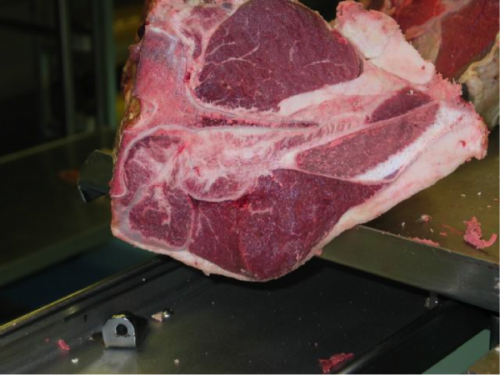
- : commonly from more than recent injuries and also found imbedded in muscles or between muscle seams or on or near bone joints.
- : scar tissue, unremarkably from very one-time injuries, with the appearance of white fatty seams or thin strands tightly leap together, making the musculus tough and unsightly.
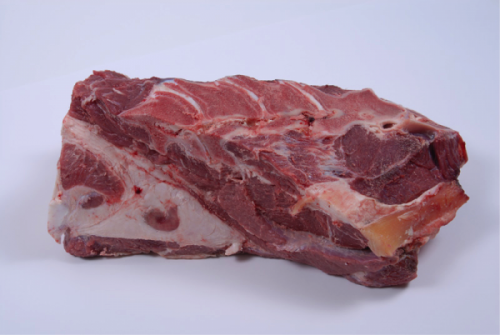
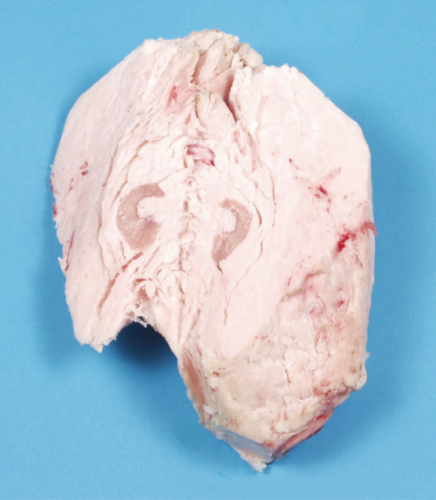
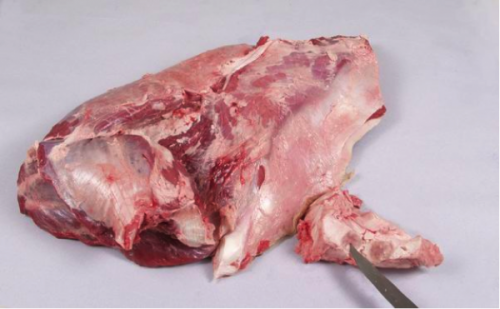
- and : lymph nodes are glands in the throat and back of the natural language that requite a good indication of the general health of the animate being; these are inspected on the animal carcass at the harvesting plant prior to being sold, but internal or intermuscular glands are not examined unless further inspection is recommended past a veterinary. Consequently, three major glands are removed from beef, pork, and lamb during processing to ensure the public practice non see them. They are the , located in the cervix and blade sub-primals below the junction of the 5th cervical vertebra (Figure 10); the , located at 90 degrees to the circular bone on the hip on the outside of the sirloin tip imbedded in the cod fat pocket (Figure 11); and the , located in the outside round sub-key in the hip primal between the eye of the round and the outside circular apartment under the heel of round, imbedded in a fat pocket (Effigy 12).
davenportbehimphe.blogspot.com
Source: https://opentextbc.ca/meatcutting/chapter/meat-colour/
0 Response to "Why Does the Outside of Meat Brown and Not the Inside Why Is the Inside of Beef Pink After It Cooked"
Post a Comment